Thursday, January 31, 2013

American Diabetes Association Tour de Cure


Please come and join the Tour de Cure with the American Diabetes Association on Saturday, April 27, 2013 @ The M Resort on 12300 S. Las Vegas Blvd. Foot, Ankle & Lower Leg Center will be one of the sponsors there, so please stop by our table! 

Register today to STOP DIABETES! 

Step 1: www.diabetes.org/tourvegas 

Step 2: Once on the NV page, select "Register to Ride" 

Step 3: Select, "Start a Team", "Join an Existing Team" or "Ride as an Individual" 

Individuals supporting someone with diabetes or Red Riders without a team can join Team Red! Ask 15 people for $10 and your ride fee is covered! 

Vegas glam and new routes from The M Resort - 8-mile, 30-mile, 65-mile and 100-mile Route Options

New VIP Perks & Dinner Friday night - Great food, energy & support - $25 registration + $150 ride free 

Register today by creating a team:

There are no team member minimum numbers of riders and each rider is responsible for his or her own ride fee! So by creating a team, you have a way to get exposure for your company or group and create momentum for the ride. Team members do not need to ride the same routes during the event. 

To get others involved:
Simply log in and send out emails from the team page with the easy, online tools. A link to YOUR team's page will automatically be placed at the end of the email. 

Ask your friends, family and work associates specifically to Join a Team or Sponsor a Rider and help create a movement to STOP DIABETES!  

Most current information and route details are on the Nevada event page. For information call Tracie Patten, ADA market manager: 702-369-9995 x7483 or tpatten@diabetes.org


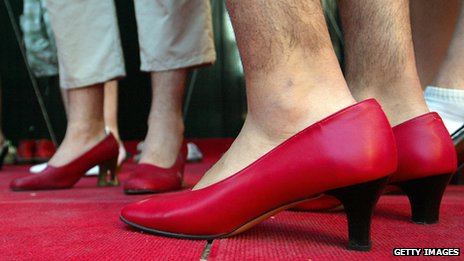
Why did men stop wearing high heels?

By William Kremer BBC World Service

For generations they have signified femininity and glamour - but a pair of high heels was once an essential accessory for men.   Beautiful, provocative, sexy - high heels may be all these things and more, but even their most ardent fans wouldn't claim they were practical.
They're no good for hiking or driving. They get stuck in things. Women in heels are advised to stay off the grass - and also ice, cobbled streets and posh floors.  And high heels don't tend to be very comfortable. It is almost as though they just weren't designed for walking in.
Originally, they weren't.  "The high heel was worn for centuries throughout the near east as a form of riding footwear," says Elizabeth Semmelhack of the Bata Shoe Museum in Toronto.  Good horsemanship was essential to the fighting styles of Persia - the historical name for modern-day Iran.  "When the soldier stood up in his stirrups, the heel helped him to secure his stance so that he could shoot his bow and arrow more effectively," says Semmelhack.
At the end of the 16th Century, Persia's Shah Abbas I had the largest cavalry in the world. He was keen to forge links with rulers in Western Europe to help him defeat his great enemy, the Ottoman Empire.
A men's 17th Century Persian shoe, covered in shagreen - horse-hide with pressed mustard seeds
So in 1599, Abbas sent the first Persian diplomatic mission to Europe - it called on the courts of Russia, Germany and Spain.  A wave of interest in all things Persian passed through Western Europe. Persian style shoes were enthusiastically adopted by aristocrats, who sought to give their appearance a virile, masculine edge that, it suddenly seemed, only heeled shoes could supply.  
 
Louis XIV wearing his trademark heels in a 1701 portrait by Hyacinthe Rigaud
As the wearing of heels filtered into the lower ranks of society, the aristocracy responded by dramatically increasing the height of their shoes - and the high heel was born.   In the muddy, rutted streets of 17th Century Europe, these new shoes had no utility value whatsoever - but that was the point.
"One of the best ways that status can be conveyed is through impracticality," says Semmelhack, adding that the upper classes have always used impractical, uncomfortable and luxurious clothing to announce their privileged status.  "They aren't in the fields working and they don't have to walk far."
When it comes to history's most notable shoe collectors, the Imelda Marcos of his day was arguably Louis XIV of France. For a great king, he was rather diminutively proportioned at only 5ft 4in (1.63m).  He supplemented his stature by a further 4in (10cm) with heels, often elaborately decorated with depictions of battle scenes.
The heels and soles were always red - the dye was expensive and carried a martial overtone. The fashion soon spread overseas - Charles II of England's coronation portrait of 1661 features him wearing a pair of enormous red, French style heels - although he was over 6ft (1.85m) to begin with.
In the 1670s, Louis XIV issued an edict that only members of his court were allowed to wear red heels. In theory, all anyone in French society had to do to check whether someone was in favor with the king was to glance downwards. In practice, unauthorized, imitation heels were available.
Red soles are back
 
  • The 17th Century shoe on the left, which may have been French, was for a child - its stacked leather heel was painted red to suggest privilege
  • "An obvious link with Louis XIV and the red sole and heel is Christian Louboutin's red sole (right), which is today one of the most immediate and recognisable status symbols," says Helen Persson from the Victoria and Albert Museum
  • But while today's fashion designers have a huge array of plastics and metals in their toolbox, it was an engineering challenge for 17th Century shoemakers to support the instep on a high heel
  • One solution was to place the heel very far forward in the shoe - this effectively transferred the problem from the shoemaker to the wearer
Although Europeans were first attracted to heels because the Persian connection gave them a macho air, a craze in women's fashion for adopting elements of men's dress meant their use soon spread to women and children.
"In the 1630s you had women cutting their hair, adding epaulettes to their outfits," says Semmelhack.  "They would smoke pipes; they would wear hats that were very masculine. And this is why women adopted the heel - it was in an effort to masculinise their outfits."
From that time, Europe's upper classes followed a unisex shoe fashion until the end of the 17th Century, when things began to change again.  "You start seeing a change in the heel at this point," says Helen Persson, a curator at the Victoria and Albert Museum in London. "Men started to have a squarer, more robust, lower, stocky heel, while women's heels became more slender, more curvaceous."
Why are high heels sexy?
Association Elizabeth Semmelhack believes that high heels began to be seen as erotic footwear when they came back into fashion in the late 19th Century - the nude models on French postcards were often wearing them
Biology Dr Helen Fischer, a biological anthropologist at Rutgers University, says that heels force women into a "natural courting pose" found amongst mammals, with an arched back and protruding buttocks
Patriarchy Not only do heels transform the way women's bodies look to please men, they cause them pain and prevent them from running away - radical feminist Sheila Jeffreys says they are one way in which women are forced to "compensate for the lack of power that men may be having"
The toes of women's shoes were often tapered so that when the tips appeared from her skirts, the wearer's feet appeared to be small and dainty.
Fast forward a few more years and the intellectual movement that came to be known as the Enlightenment brought with it a new respect for the rational and useful and an emphasis on education rather than privilege. Men's fashion shifted towards more practical clothing. In England, aristocrats began to wear simplified clothes that were linked to their work managing country estates.
It was the beginning of what has been called the Great Male Renunciation, which would see men abandon the wearing of jewelry, bright colors and ostentatious fabrics in favor of a dark, more sober, and homogeneous look. Men's clothing no longer operated so clearly as a signifier of social class, but while these boundaries were being blurred, the differences between the sexes became more pronounced.
"There begins a discussion about how men, regardless of station, of birth, if educated could become citizens," says Semmelhack.
"Women, in contrast, were seen as emotional, sentimental and uneducated. Female desirability begins to be constructed in terms of irrational fashion and the high heel - once separated from its original function of horseback riding - becomes a primary example of impractical dress." 
High heels were seen as foolish and effeminate. By 1740 men had stopped wearing them altogether.  But it was only 50 years before they disappeared from women's feet too, falling out of favor after the French Revolution.  By the time the heel came back into fashion, in the mid-19th Century, photography was transforming the way that fashions - and the female self-image - were constructed.
Pornographers were amongst the first to embrace the new technology, taking pictures of naked women for dirty postcards, positioning models in poses that resembled classical nudes, but wearing modern-day high heels. Semmelhack, author of Heights of Fashion: A History of the Elevated Shoe, believes that this association with pornography led to high heels being seen as an erotic adornment for women.
A rare sight - men in high heels at a gay pride party in Spain in 2005
The 1960s saw a return of low heeled cowboy boots for men and some dandies strutted their stuff in platform shoes in the 1970s.  But the era of men walking around on their toes seems to be behind us. Could we ever return to an era of guys squeezing their big hairy feet into four-inch, shiny, brightly colored high heels?
"Absolutely," says Semmelhack. There is no reason, she believes, why the high heel cannot continue to be ascribed new meanings - although we may have to wait for true gender equality first.  "If it becomes a signifier of actual power, then men will be as willing to wear it as women."
The Foot, Ankle & Lower Leg Center office is located in the Las Vegas and the Henderson area, which we have 2 convenient locations to serve you.  To take the first step to better foot health, call today @702-878-2455, Monday thru Friday, between 9am to 5pm and closed for lunch between 1pm to 2pm.  Please visit our website @ www.FallCenter.com where all of your questions may be answered and to schedule your appointment on-line.
 
When pain or injury occurs, you deserve highly personalized treatment using the most advanced techniques.  At the Foot, Ankle & Lower Leg Center (FallCenter), you’ll enjoy an unsurpassed level of quality care.  Dr. Ricciardi, Dr. Shalev and Dr. McLeod are proud to provide comprehensive solutions for all types of foot and ankle problems. 
Your quality care begins the minute you arrive, as our staff greets you by name and answers your questions.  Our team of foot and ankle specialists will inspire your confidence and their genuine warmth and compassion will earn your trust.
You’ll receive a prompt and thorough assessment, including on-site diagnostic ultrasound and digital x-rays.  Your treatment plan is designed to resolve your condition without surgery whenever possible.  When surgery is needed, your feet are in the hands of leading foot surgeons with expertise in the latest minimally invasive techniques.  As a result, you’ll be back on your feet and back to your active life as quickly as possible.
Without proper treatment, an injury or chronic condition can keep you from performing even the simplest everyday tasks..  To meet patients’ most critical health needs,
Dr. Ricciardi, Dr. Shalev and Dr. McLeod have developed the following treatment programs:  Bunion Solutions, Heel Pain, Diabetic Foot Care and Sports Medicine.


Wednesday, January 16, 2013

Common Foot Problems


(AND WHAT TO DO ABOUT THEM)

Published by:  American Podiatric Medical Association

 DID YOU KNOW?  The average person takes between 8,000 and 10,000 steps each day. In a lifetime, that equals to 4 trips around the globe! 

Warts

Common warts, which can appear anywhere on the body, are rough little bumps. Plantar warts, which occur on the bottom of the feet, are typically hard, flat, and rough. All warts are caused by a virus. Warts aren’t harmful, but they can be uncomfortable and unsightly. If you have warts on your feet, keep your feet clean and dry. (Viruses flourish in dark, wet environments). 

Smelly Feet

Feet sweat. You can cut down on odors by keeping your feet clean and dry at all times. (It’s OK to stash some extra socks at school!) Rubbing powder on the bottom of your feet before putting on your socks and shoes can help too. If possible, let shoes air out for 24 hours before wearing them again. Foot doctors, called podiatrists, can help people with particularly smelly feet. 

Ingrown Toenails

Symptoms of an ingrown toenail include redness, swelling, and tenderness around the nail. Sometimes you can even see the nail digging directly into the toe. Try soaking the affected foot in lukewarm water and Epsom salts for 20 minutes three or four times a day. If the redness and pain doesn’t improve after a couple days, see a doc. Podiatrists can easily treat ingrown toenails. 

Athlete’s Foot

Athlete’s foot, an itchy foot condition that causes the skin to flake and peel, is caused by a fungus. Keeping your feet clean and dry can help. So can over-the-counter athlete’s foot medication. Just be sure to use the medication until the fungus is completely gone. With current medications, two to three weeks of treatment may be enough to treat athlete’s foot fungus. Stubborn cases of athlete’s foot may require a doctor’s care.  

The Foot, Ankle & Lower Leg Center office is located in the Las Vegas and the Henderson area, which we have 3 convenient locations to serve you.  To take the first step to better foot health, call today @702-878-2455, Monday thru Friday, between 9am to 5pm and closed for lunch between 1pm to 2pm.  Please visit our website @ www.FallCenter.com where all of your questions may be answered and also to schedule your appointment On-line.

When pain or injury occurs, you deserve highly personalized treatment using the most advanced techniques.  At the Foot, Ankle & Lower Leg Center (FallCenter), you’ll enjoy an unsurpassed level of quality care.  Dr. Ricciardi, Dr. Shalev and Dr. McLeod are proud to provide comprehensive solutions for all types of foot and ankle problems. 
Your quality care begins the minute you arrive, as our staff greets you by name and answers your questions.  Our team of foot and ankle specialists will inspire your confidence and their genuine warmth and compassion will earn your trust.

You’ll receive a prompt and thorough assessment, including on-site diagnostic ultrasound and digital x-rays.  Your treatment plan is designed to resolve your condition without surgery whenever possible.  When surgery is needed, your feet are in the hands of leading foot surgeons with expertise in the latest minimally invasive techniques.  As a result, you’ll be back on your feet and back to your active life as quickly as possible.
Without proper treatment, an injury or chronic condition can keep you from performing even the simplest everyday tasks.  To meet patients’ most critical health needs,
Dr. Ricciardi, Dr. Shalev and Dr. McLeod have developed the following treatment programs: Bunion Solutions, Heel Pain, Diabetic Foot Care and Sports Medicine.

How to Choose the Right Shoe


Published by: American Podiatric Medical Associates (APMA)

Consider the activity.

Basketball shoes are different than ballet shoes for a reason.  Sports-specific shoes help protect against injury by providing appropriate support. Basketball shoes, for instance, provide extra ankle support, because the movements from side to side that are typical in basketball put strain on the ankles.

Get fitted.

If you need an athletic shoe, visit a store that specializes in athletic footwear. The associates there can help you find a shoe that’s appropriate for your foot, the way you walk, and your sport. Look for a shoe that fits your foot, but don’t get hung up on size. Shoe sizes, like clothes sizes, can vary from brand to brand. You want a pair of shoes that fits comfortably on the first try.  Your feet are not usually the same size. Make sure that you always buy shoes based on your larger foot’s size. You should never have to break-in a pair of athletic shoes.

 Check for support.

The best shoes support your foot, front and back. Backless shoes actually alter the way you walk, and that can cause foot injuries and discomfort down the line. You don’t have to give up your lip-flops; you just shouldn’t wear them all the time. Look for shoes that are stiff in the middle, but bend at the ball of the foot. High heels are OK for special occasions. Consider selecting platform or wedge heels instead of stilettos. 

Watch for signs of wear.

When your shoes start wearing out, it’s time for a new pair. Check the tread and midsole, the cushiony part just before the sole. If the shoe displays signs of uneven wear, it’s time to look for a new pair of shoes. Athletic shoes should be replaced yearly; running shoes should be replaced every 300–400 miles or so. 

Find Healthy Shoes at WWW.APMA.ORG/SEAL 

The Foot, Ankle & Lower Leg Center office is located in the Las Vegas and the Henderson area, which we have 3 convenient locations to serve you.  To take the first step to better foot health, call today @702-878-2455, Monday thru Friday, between 9am to 5pm and closed for lunch between 1pm to 2pm.  Please visit our website @ www.FallCenter.com where all of your questions may be answered and also to schedule your appointment On-line. 

When pain or injury occurs, you deserve highly personalized treatment using the most advanced techniques.  At the Foot, Ankle & Lower Leg Center (FallCenter), you’ll enjoy an unsurpassed level of quality care.  Dr. Ricciardi, Dr. Shalev and Dr. McLeod are proud to provide comprehensive solutions for all types of foot and ankle problems. 
Your quality care begins the minute you arrive, as our staff greets you by name and answers your questions.  Our team of foot and ankle specialists will inspire your confidence and their genuine warmth and compassion will earn your trust.
You’ll receive a prompt and thorough assessment, including on-site diagnostic ultrasound and digital x-rays.  Your treatment plan is designed to resolve your condition without surgery whenever possible.  When surgery is needed, your feet are in the hands of leading foot surgeons with expertise in the latest minimally invasive techniques.  As a result, you’ll be back on your feet and back to your active life as quickly as possible.
Without proper treatment, an injury or chronic condition can keep you from performing even the simplest everyday tasks.  To meet patients’ most critical health needs,

Dr. Ricciardi, Dr. Shalev and Dr. McLeod have developed the following treatment programs: Bunion Solutions, Heel Pain, Diabetic Foot Care and Sports Medicine.

Thursday, December 27, 2012

Keep Your Feet Safe at the Gym in the New Year


Published by: The American College of Foot and Ankle Surgeons
Don’t let foot injuries keep you from your fitness resolutions

In the New Year, don’t forget to keep your feet in tip-top shape while following through with your resolutions to get fit. The American College of Foot and Ankle Surgeons offers tips for foot safety while at the gym.

Start new workouts gradually— Increase your stamina and the length of your workouts gradually to avoid overuse injuries such as stress fractures or tendon strains and sprains. Stretching your muscles before and after workouts also helps prevent these types of injuries. “If you do feel you’ve sprained your ankle, be sure to seek treatment right away,” Florida foot and ankle surgeon, Brandi M. Johnson, DPM, FACFAS, explains. “Untreated or repeated ankle sprains may lead to chronic ankle instability, a condition that causes persistent pain and a ‘giving way’ of the ankle.”

Wear the right shoe and sock—Wear well-fitting athletic shoes designed for the exercise or sport. According to Dr. Johnson, shoes that don’t support the arch of the foot and provide cushion for the heel can cause heel pain (plantar fasciitis). Shoes that are too small can also cause a neuroma or a thickening of the nerve tissue, in the foot and may require injections, medication or physical therapy. Wearing cotton or non-slip socks are also key to help avoid painful blisters, which can become infected and cause more serious issues.

Use good technique— improper exercise techniques can result in injury to the tendons or ligaments in your feet and ankles. “Incorrect posture or misuse of exercise equipment can cause decreased stabilization in the foot and ankle, leading to joint sprains and muscle strains,” Dr. Johnson says.

Protect yourself from bacteria—Sweaty shoes, public showers, exercise equipment and the pool deck at the gym are breeding grounds for fungus, viruses and bacteria, including drug-resistant strains like MRSA (methicillin-resistant Staphylococcus aureus) which has become increasingly more common. Never go barefoot while in public areas; water shoes can provide a great barrier between your feet and the wet surfaces. “It’s also best to cover cuts and cracks in the skin or ingrown toenails since these minor tears in the skin’s surface can act as entry points for bacteria. If you have a cut or scrape that becomes red or swollen and is not healing in a timely manner, don’t hesitate to see a foot and ankle surgeon for an examination,” Dr. Johnson says.

Above all, it’s important to listen to your body. If you experience an injury or pain, call your foot and ankle surgeon.
 

The Foot, Ankle & Lower Leg Center office is located in the Las Vegas and the Henderson area, which we have 3 convenient locations to serve you.  To take the first step to better foot health, call today @702-878-2455, Monday thru Friday, between 9am to 5pm and closed for lunch between 1pm to 2pm.  Please visit our website @ www.FallCenter.com where all of your questions may be answered and also to schedule your appointment On-line. 

When pain or injury occurs, you deserve highly personalized treatment using the most advanced techniques.  At the Foot, Ankle & Lower Leg Center (FallCenter), you’ll enjoy an unsurpassed level of quality care.  Dr. Ricciardi, Dr. Shalev and Dr. McLeod are proud to provide comprehensive solutions for all types of foot and ankle problems. 
Your quality care begins the minute you arrive, as our staff greets you by name and answers your questions.  Our team of foot and ankle specialists will inspire your confidence and their genuine warmth and compassion will earn your trust.
You’ll receive a prompt and thorough assessment, including on-site diagnostic ultrasound and digital x-rays.  Your treatment plan is designed to resolve your condition without surgery whenever possible.  When surgery is needed, your feet are in the hands of leading foot surgeons with expertise in the latest minimally invasive techniques.  As a result, you’ll be back on your feet and back to your active life as quickly as possible.
Without proper treatment, an injury or chronic condition can keep you from performing even the simplest everyday tasks.  To meet patients’ most critical health needs,
Dr. Ricciardi, Dr. Shalev and Dr. McLeod have developed the following treatment programs: Bunion Solutions, Heel Pain, Diabetic Foot Care and Sports Medicine.

Tuesday, December 11, 2012

Balancing act


Published by: American College of Foot and Ankle Surgeons
The wrong boot could lead to ankle, foot injuries

Winter’s popular women’s boots typically feature tall, spiked heels and narrow, pointed toes. These boots can make your feet unstable on snow- and ice-covered surfaces.

A stylish low-heeled winter boot is a lot more fashionable than a cast and crutches. We recommend women scuff-up the soles of new boots, or purchase adhesive rubber soles, to provide greater traction.
Falls from high-heeled winter boots can lead to a number of injuries, depending on how you lose your balance. If your ankles roll inward or outward, you can break your ankles. If your ankle twists, ligaments can be stretched or torn, causing an ankle sprain. Broken and sprained ankles can be present at the same time. Slipping or falling in these boots can also cause broken toe, metatarsal and heel bones.

If you do get hurt, call a foot and ankle surgeon for prompt evaluation and treatment. In the meantime, the “R.I.C.E.” method should be followed. This involves:
Rest. Stay off the injured foot, since walking can cause further damage.
Ice. To reduce swelling and pain, apply a bag of ice over a thin towel to the affected area. Do not put ice directly against the skin. Use ice for 20 minutes and then wait at least 40 minutes before icing again.
Compression. An elastic wrap should be used to control swelling.
Elevation. Keep the foot elevated to reduce the swelling. It should be even with or slightly above the heart level.


Tips to avoid winter ankle injuries:

·         Keep areas around outside doorways well-lit so icy patches are visible
·         Wear shoes or boots with a traction sole that can prevent slipping
·         Check for slippery spots before getting out of a car or walking on stairs
·         Avoid wearing high-heeled shoes outdoors
·         Stretch and warm up before outdoor and indoor physical activities

Call the Foot, Ankle & Lower Leg Center office located in Las Vegas and the Henderson area, which we have 3 locations to serve you.  Call to schedule your appointment

 @702-878-2455 between 9am to 5pm, Monday thru Friday and closed for lunch between 1pm to 2pm.  Please visit our website @ www.FallCenter.com where all of your questions may be answered and to also schedule your appointment.
When pain or injury occurs, you deserve highly personalized treatment using the most advanced techniques.  At the Foot, Ankle & Lower Leg Center (FallCenter), you’ll enjoy an unsurpassed level of quality care.  Dr. Ricciardi, Dr. Shalev and Dr. McLeod are proud to provide comprehensive solutions for all types of foot and ankle problems. 
Your quality care begins the minute you arrive, as our staff greets you by name and answers your questions.  Our team of foot and ankle specialists will inspire your confidence and their genuine warmth and compassion will earn your trust.
You’ll receive a prompt and thorough assessment, including on-site diagnostic ultrasound and digital x-rays.  Your treatment plan is designed to resolve your condition without surgery whenever possible.  When surgery is needed, your feet are in the hands of leading physicians with expertise in the latest minimally invasive techniques.  As a result, you’ll be back on your feet and back to your active life as quickly as possible.
Without proper treatment, an injury or chronic condition can keep you from performing even the simplest everyday tasks.  To meet patients’ most critical health needs,

Dr. Ricciardi, Dr. Shalev and Dr. McLeod have developed the following treatment programs:  Bunion Solutions, Heel Pain, Diabetic Foot Care and Sports Performance Center.

Wednesday, December 5, 2012

Obesity Doubles Ankle Fracture Risk


Study shows severity of ankle fractures increases as body mass index increases

Obesity nearly doubles the odds of a patient having the most severe category of ankle fracture, according to research published in a recent issue of the American College of Foot and Ankle Surgeons’ Journal of Foot and Ankle Surgery (JFAS).
The study, which was conducted among 280 patients, explored the association between obesity and severity of ankle fractures. It analyzed the X-rays of each patient’s ankle fracture and classified the severity of each one. Body mass index (BMI), age, diabetes, tobacco use, osteoporosis, sex and age were then assessed alongside each patient’s ankle fracture classification. The study attests that being overweight or obese is associated with an increased risk of musculoskeletal problems; specifically in this case, increased risk of having a severe ankle fracture. The increase in weight can have grave effects on the bone and joints, increasing the risk of osteoarthritis and (potentially) the need for total joint replacement at a younger age.
Obesity (classified as BMI of 30 kg/m2 or greater) is becoming more prevalent in America and so are musculoskeletal issues associated with it. The healthy ankle joint allows for normal walking, and injuries to the joint, including fractures, can have devastating effects if not properly addressed. The recent study identified a correlation between more severe ankle fractures and obesity, especially for obese men younger than 25, and obese women older than 50.
Alan MacGill, DPM, AACFAS, a Florida foot and ankle surgeon and Associate Member of the American College of Foot and Ankle Surgeons, says, “We are seeing more severe injury patterns in the obese population compared to the non-obese. These severe ankle fractures tend to have a worse prognostic outcome compared to others.”
This is likely due to the fact that severe ankle fractures tend to be higher in the fibula, above the level of the ankle joint. The twisting motion of the injury not only breaks the bone but also tears the ligaments that hold the lower leg bones (fibula and tibia) together for stability of the ankle joint.
Dr. MacGill adds, “The findings of this study correlate with what I continue to see in my practice. It’s basic physics; as body mass increases, so does the kinetic energy associated with the injury. The higher the body mass, the greater the risk of more severe ankle injury.”
There’s not much that can be done to prevent these types of injuries, as ankle fractures cannot be predicted. But bearing the results of this study, this is yet another reason to maintain a healthy diet, exercise plan and body weight to possibly help decrease the likelihood of an ankle injury being more severe.
"The ankle is a relatively small joint that bears much more force than the knee or hip. Fractures of any sort that disrupt the integrity of the ankle can have devastating consequences, such as ankle instability, post-traumatic arthritis, and chronic joint pain, especially in those who are overweight. Because of the complexity of the joint, it’s important to have these and any other ankle injuries evaluated by a foot and ankle surgeon,” MacGill says.
Please call Foot, Ankle & Lower Leg Center office located in Las Vegas and the Henderson area, which we have 3 locations to serve you.  Call to schedule you appointment @702-878-2455 between 9am to 5pm, Monday thru Friday and closed for lunch between 1pm to 2pm.  Please visit our website @ www.FallCenter.com where all of your questions may be answered and to also schedule your appointment.
When pain or injury occurs, you deserve highly personalized treatment using the most advanced techniques.  At the Foot, Ankle & Lower Leg Center (FallCenter), you’ll enjoy an unsurpassed level of quality care.  Dr. Ricciardi, Dr. Shalev and Dr. McLeod are proud to provide comprehensive solutions for all types of foot and ankle problems. 
Your quality care begins the minute you arrive, as our staff greets you by name and answers your questions.  Our team of foot and ankle specialists will inspire your confidence and their genuine warmth and compassion will earn your trust.
You’ll receive a prompt and thorough assessment, including on-site diagnostic ultrasound and digital x-rays.  Your treatment plan is designed to resolve your condition without surgery whenever possible.  When surgery is needed, your feet are in the hands of leading physicians with expertise in the latest minimally invasive techniques.  As a result, you’ll be back on your feet and back to your active life as quickly as possible.
Without proper treatment, an injury or chronic condition can keep you from performing even the simplest everyday tasks.  To meet patients’ most critical health needs, Dr. Ricciardi, Dr. Shalev and Dr. McLeod have developed the following treatment programs: Bunion Solutions, Heel Pain, Diabetic Foot Care and Sports Performance Center.